
While working on Pika’s live conversation cards, I noticed a simple problem. The card could tell me that someone was asking a question without giving me anything useful to say. I could already hear the question. I needed a line I could start with.
Here’s a made-up example. Someone asks how I tested a caching fix. A useful card could suggest, “I started by reproducing the bug with the cache turned off.” That line is only useful if I actually did it. Pika shouldn’t fill in my experience when it doesn’t know what happened.
What I changed
The old prompt mixed a short-answer rule with instructions for answering interview questions. It also told the model to skip when it couldn’t answer without adding details. In practice, the model sometimes skipped the card or described the question.
I changed the prompt to ask for the words to say. For a question, the card gives a possible reply. For an unfamiliar term, it gives a short explanation and an example. A suggested answer can use an example detail, but it shouldn’t present that detail as a fact about the user.

What the replay showed
I replayed the same 126 moments from one recorded class locally. I ran the new version with the answer language set and with it left blank. A card can appear on time and still be hard to use if it comes back in the wrong language.
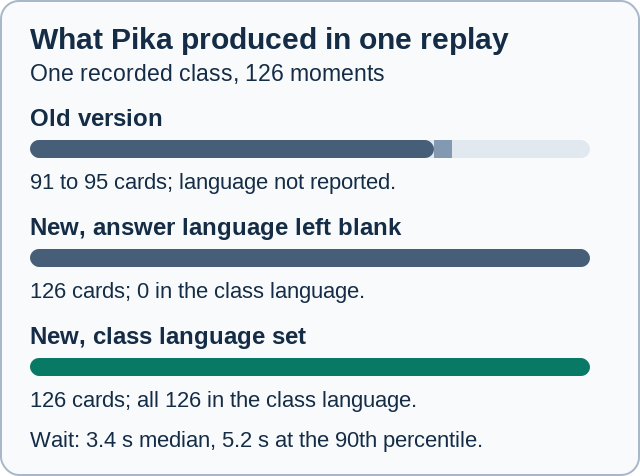
The old version missed 31 to 35 cards. The new version produced a card for all 126 moments in both runs. With the language setting left blank, all 126 were in Chinese, my reading language in this replay. With the class language set, all 126 used it. The median wait in that run was 3.4 seconds, and the 90th percentile was 5.2 seconds. Pull request and replay notes
This was one local replay with my configured model. It measured whether a card appeared, what language it used, and how long it took. I didn’t use it to rate the quality of the suggested replies or measure production performance.
Why I changed the logs too
A provider error used to look like the model chose to skip. If the model skipped, I want to look at the prompt. If the call failed, I want to look at the provider request. Pika now records whether each card was produced, skipped, timed out, or failed, along with how long the attempt took. These events don’t include transcript text.
My next test would be to mix the old and new cards without identifying the version. For each pair, I’d ask a reader which line actually answers the question and whether they’d say it as written. I’d score factual mistakes separately. That’s how I’d test the thing the card is for.