
I spend hours a day reading and writing with Claude Code. Lingo, a Claude Code plugin I built, turns those hours into language practice. It puts a translation under each prompt and reply, previews my drafts in the language I am learning, and turns the words I used into flashcards. The plugin covers 11 languages, and the notes and explanations can use any of the other 10.
A translation must not read as Claude’s words
That was the first rule, and it shaped the whole design. Every translation carries three marks at once: a language tag such as EN or FR, italic text, and the theme accent color. One mark alone is not enough. Together they make a translation unmistakable in every theme.
I rejected two layouts before settling on this one. A side pane puts the translation too far from the source. There is no room for it on phones or narrow windows. A folded tag on every message costs a click per message. The interlinear gloss won: the translation sits directly under the message it belongs to.
Then cost changed the default. Since 0.2.6 the gloss starts folded. Nothing is translated, or paid for, until you open it. The click mattered less than paying for a translation on every message.
One call for a long reply
A long reply needs a translation under each paragraph. One call per paragraph would multiply the cost and risk putting translations under the wrong paragraphs. Version 0.6.0 translates a long reply in one call instead.
The work happens locally, before any model call. A pure function splits the reply into chunks. A code fence stays whole and is never sent. A list is one segment. A heading joins the paragraph after it. A table drops its separator row, and a quote drops its > marker. The split caps at 40 chunks, and the rest merge into the last one.
Only long replies take this path: 3 or more prose segments, or 2 in a text of 600 or more characters. Shorter texts keep a single translation under the whole message.
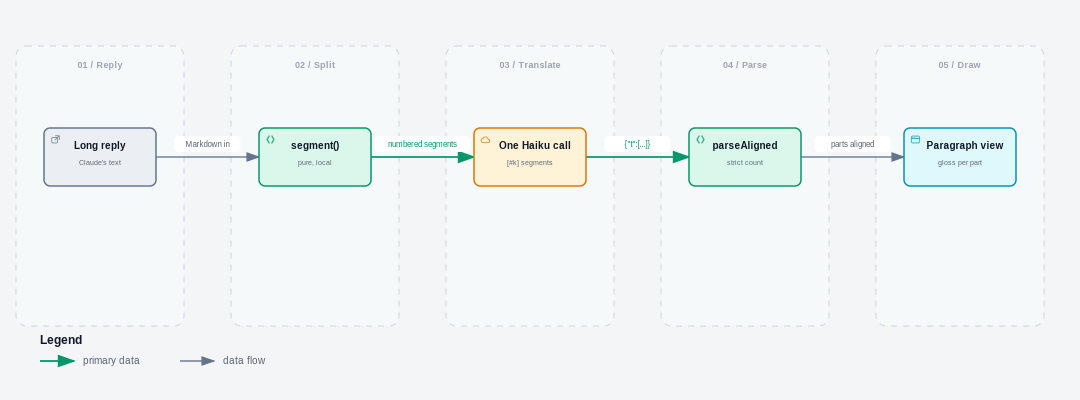
The call sends the segments numbered, [#1], [#2], and asks for exactly one string per segment in {"t":[...]}. Paths, commands and flags stay verbatim. When the whole message is already in the target language, the model answers {"same":true} and nothing is drawn.
The parser does not trust the shape of the answer. A wrong-length or non-JSON answer is kept as a whole translation, with no second call. A broken answer triggers one whole-text retranslation. An answer cut off at the token cap keeps its complete items and ends with …. After three misses in a row, the aligned prompt stays off for the rest of the session.
I checked this live on 2026-11-10 with Claude Code 2.1.321 and Haiku 5.5. One call, parts aligned, paths and commands kept, code not sent. The desktop app, mobile, and a small local model are not yet checked.
Flashcards without another model call
The words come from the preview. When you send a previewed draft, its key words go into a deck for that language. There is no extra model call. Nothing is saved for drafts you abandon, and nothing is saved for polish suggestions.
The scheduler is SM-2, written as pure code that never mutates a card. Ease starts at 2.5 and never drops below 1.3. A new card answered Good comes back in 2 days, then 5, then 13, then 33. Easy is always at least a day past Good. That last rule was a real fix in 0.5.0: at short intervals, Good and Easy once gave the same day. Again means a 10 minute relearn.
Each card keeps the sentence it came from, so the word stays in context. A session reviews at most 20 due cards, most overdue first, then at most 10 new ones. A card counts as due 4 hours early, so a daily habit is not missed by minutes.
The deck caps at 500 cards. Past the cap, the card with the longest interval leaves first, never one added in that same call. A card id is a hash of the normalized word, so the same word cannot enter twice.
What it costs
By default each translation is one short Haiku call through the account Claude Code already uses. Folded translations cost nothing until opened. A long reply is still one call. Flashcards never call the model.
The plugin also works with any OpenAI-compatible endpoint, including local ones. Ollama, LM Studio, OpenRouter and Groq are all supported, with the model set in /config. A local model costs nothing per call.
Lingo is MIT licensed. I built the first version in five days, 2026-11-06 to 2026-11-10. The two releases in that span were 0.5.0 for flashcards and 0.6.0 for the paragraph view.