
I recently read Anthropic’s article about Tasks, Elicitation, and Skills over MCP. The section on long-running tasks sounded familiar. I went back to MCP Task Relay, a project I built in November 2025, to see how close the two designs really were.
What I found in the old code was a decision I still agree with: when an agent hands off a job, the job needs its own record. The chat can move on while the work continues. When the job is done, someone should be able to check what happened.
Why I built Relay that way
A code change is a good example. I can ask a worker to update a dependency and run the tests. That may take several minutes. If the request ends before the job does, I still want to know whether the worker is running. When it finishes, I want to see the patch and know which commit it started from.
So Relay gave each job an ID. The caller submitted a starting commit and a list of requirements. It could check the job status later and collect the patch and notes. Relay also let a worker ask another model a question during the job. In a November 12 commit, I added a way to send the facts needed for that question without passing the whole chat. A hash check could catch a mismatch in those facts. It couldn’t tell me whether the answer was right.
What MCP had then and what Claude supports now
When I built Relay, MCP already let a client call server tools. The June 2025 spec had also added Elicitation, so servers could ask users for more information. But the published spec at the time had no standard task lifecycle. Relay used its own job tools for that. Later that month, the November 25, 2025 revision introduced Tasks as an experimental feature.
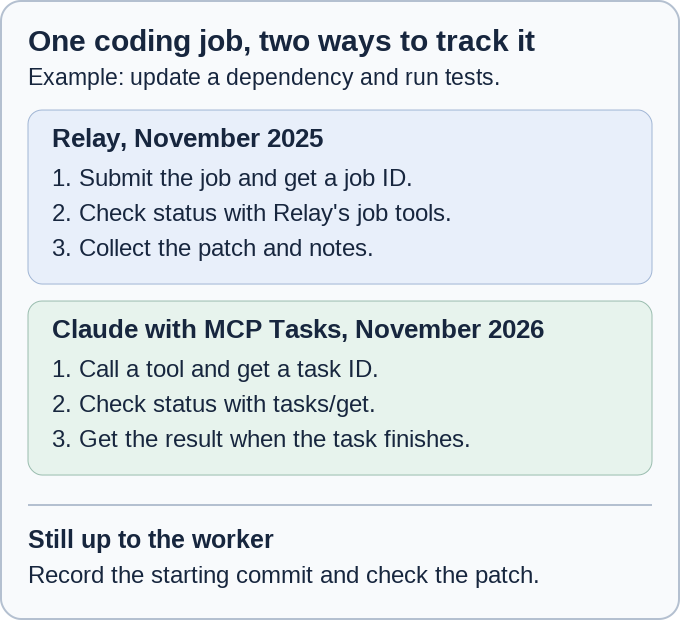
A year later, Anthropic announced general availability for Tasks and Elicitation in Claude on supported plans. With Tasks, a server can give Claude a task ID, keep working, and return the result when Claude checks back. If a deployment needs permission to create a paid resource, Elicitation lets the server ask the user. That’s different from Relay asking another model for technical advice. Skills over MCP, now in public beta in Claude, lets a server share instructions that Claude loads when needed, such as what to check before a deployment.
What I would change in Relay today
I’d use MCP Tasks for the parts the client and server need to agree on: how to check progress and how to get the result. I’d keep the code checks in Relay. If the task says “completed,” I still want to open the patch and check that it applies to the commit the worker was given. That was the reason I built Relay in the first place.